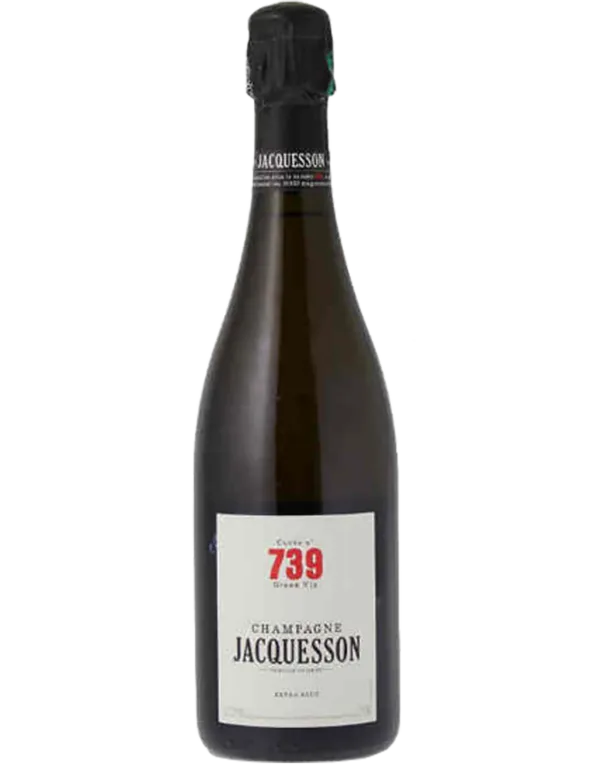
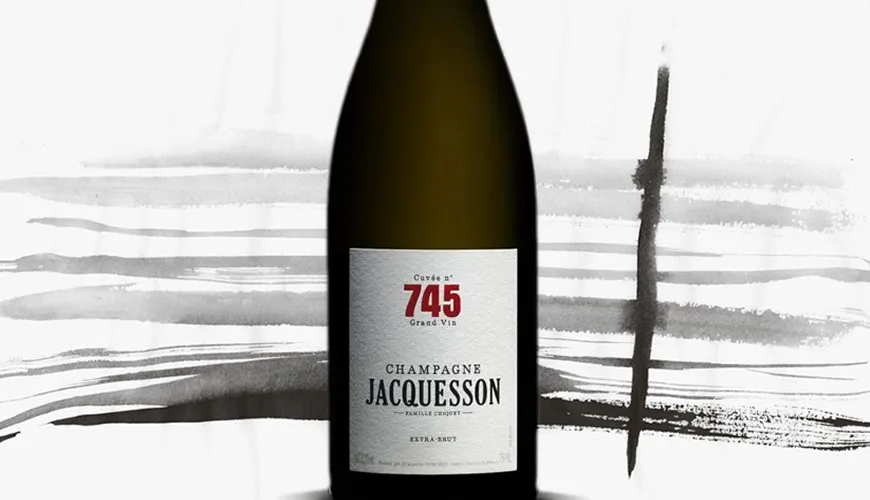
The 2017 harvest has given birth to the latest Jacquesson Cuvée, 745. A blend of vintage wines from dozens of plots, completed by a small proportion of “de réserve” wines kept in the cellar for several years.
745 continues Jacquesson’s usual numbering, a hallmark of the house used to highlight the different personalities of its wines. Among the first to introduce the concept of sans année, the Chiquet brothers, who run the house, do not aim for consistency but for making the best possible blend every year: all resources come together in a single bottle, in the spirit of the vintage and the reserve wines, for a Champagne that is unique and different every time.
For Cuvée 745 Jacquesson, the grapes come from Aÿ, Dizy, Hautvillers (66%), Avize and Oiry (34%). In 2017 winter and spring were particularly wet, and in April some late frosts devastated the vineyards. The weather settled in July, with higher temperatures at the end of the month; late August was just as hot, but rainy. The harvest took place from 4 to 13 September, with a rigorous selection of the grapes: the yield was low, but the chosen bunches were ripe and healthy, and the wines rich and dense.
205,164 bottles of Cuvée 745 were produced, plus 8,082 magnums and 250 jeroboams.
The final dosage is 0.75 g/l.
The originality of the numbered Cuvées
Cuvée 744, 743, 742, all the way back to the first numbered bottle: what made Jacquesson original and recognisable from the start is the choice to give each new Champagne a serial number.
It refers to the vintage and its weather, with a production philosophy that, especially in recent years, puts the grapes’ place of origin ahead of the percentages used in the blend.
So 744, for example, refers to the 2016 harvest, with the usual optimal ripeness of Pinot Noir and Meunier grapes from Aÿ, Dizy and Hautvillers and of Chardonnay from Avize and Oiry.
From Memmie Jacquesson to the Chiquet brothers
The house bears the name of Memmie Jacquesson, who founded it in 1798 and won great acclaim right from the start thanks to the quality of its wines. In 1810 Jacquesson Champagne even received a gold medal for the “Beauté et la Richesse de ses Caves” from Napoleon, the highest honour a commercial enterprise could receive at the time.
The founder’s promising business was carried on by his son, Adolphe Jacquesson, who gave an innovative boost to the company and to the wine world as a whole: with the support of Jules Guyot, he introduced in the vineyard the planting and pruning technique that bears Guyot’s name, which then spread all over the world. In the following years he patented the wire “cage” for bottle corks, an extraordinary invention that solved the major problems caused by the string used in those days.
After his death the house fell into decline, and was rescued in 1925 by Léon de Tassigny, the man who revived Jacquesson’s fortunes.
Today the glorious spirit of the Jacquesson family lives on thanks to the Chiquet brothers, who run the house. Their aim is to produce an exclusive blend, better every time, that fully represents the harvest. Each Cuvée comes largely from grapes of the same vintage, with a quality, non-industrial production of about 250,000 bottles.
Proof of the Chiquet brothers’ great ambition and of their strong determination to carry on the Jacquesson soul lies in the fact that, despite its success, production has never been increased and the grapes still come from the 28 hectares of its own vineyards.
Only the first-pressing juice from the three Grand Cru and two Premier Cru villages is used, for a Grand Vin de Champagne made through rigorous winemaking and optimal ageing, which is why each bottle is released in order of maturity rather than chronologically.
The soils and the Jacquesson method
The Jacquesson house is in Dizy, near Aÿ and Avize, at the foot of the Montagne de Reims. The climate is harsh and is partly responsible for the typicity of the terroirs, made great by the alchemy between natural elements and human labour.
In the vineyard, the Jacquesson method relies on little or no fertilisation, ploughing, cover cropping and low bud loads, with the aim of highlighting the individuality of each plot. The traditional methods used allow the soil to express itself perfectly, bringing out the singularity of each plot and giving the Champagnes their personality.
The vintage grapes are generally Chardonnay, Pinot Meunier and Pinot Noir; adding a small percentage of reserve wines contributes to the Champagne’s complexity without robbing it of the character of the vintage, which is showcased superbly every time.
Jacquesson’s production method also stands out for its dosages, always very low, to preserve the wine’s finesse and purity, below the maximum limit for Extra Brut.